HYPOTHERMIA PREVENTION & FIRE SAFETY · NFPA COMPLIANT
Winter Heating Safety & Micro-Room Insulation
Direct Answer: How to Stay Warm Without Power SafelyCDC & NFPA Standards
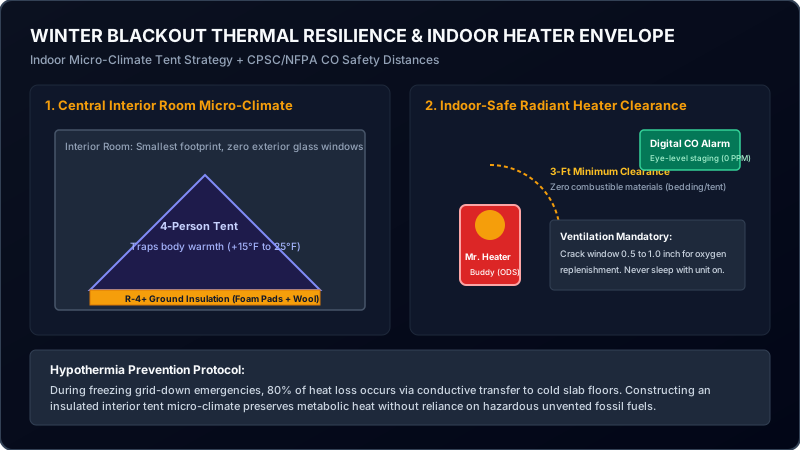
To survive sub-freezing temperatures during a winter grid blackout, do not attempt to heat your entire house. Establish an insulated "micro-room" by choosing a small, interior room with few windows, hanging wool blankets over doors/windows, or pitching a 4-person camping tent inside your living room. For auxiliary heat, use ONLY an indoor-safe propane heater equipped with an Oxygen Depletion Sensor (ODS) and accidental tip-over shutoff (e.g., Mr. Heater Buddy, CSA 4.98 certified). Keep a battery-powered carbon monoxide detector inside the room. Never use gas ovens, outdoor camping heaters, or charcoal grills indoors.
The Indoor Camping Strategy: The Micro-Climate Tent
The human body constantly generates approximately 100 Watts of thermal energy ($340\text{ BTU/hr}$) at rest. In an unheated $2,000\text{ sq ft}$ home, that heat instantly disperses into high ceilings and cold exterior walls.
The Solution: Pitch a conventional nylon camping tent on a rug or carpet in an interior room. Place closed-cell foam sleeping pads on the floor to prevent conductive heat loss to the ground. Four family members sleeping inside a small tent will raise the ambient interior temperature by 15°F to 25°F above the surrounding room temperature through retained metabolic heat alone!
If auxiliary combustion heating is required, you must understand the difference between outdoor-only heaters and certified indoor units:
What is an Oxygen Depletion Sensor (ODS)?
Heaters approved for indoor recreational use (ANSI Z21.103 / CSA 4.98 standard, such as the Mr. Heater Portable Buddy) feature an integrated Oxygen Depletion Sensor. If ambient oxygen levels in the room drop below 18% (normal atmospheric air is 20.9%), the pilot flame naturally lifts off the thermocouple, shutting off the gas valve automatically before lethal carbon monoxide can accumulate. Always crack a nearby window 1/2 inch to ensure fresh airflow.
Debunking the Lethal "Candle & Flower Pot" Myth
Social media videos frequently promote "heating a room with 4 tea light candles and an inverted terracotta flower pot."
The Fire Department Warning on Candle Heaters
A standard tea light candle produces only 75 to 100 BTUs. Four candles generate at most 400 BTUs—less thermal energy than a resting adult! Furthermore, enclosing multiple burning paraffin wax candles under an inverted clay pot traps radiant heat, causing the wax pool to reach its flashpoint temperature. This causes a sudden, explosive wax vapor fire that cannot be extinguished with water. Fire departments report hundreds of structure fires caused by this debunked Pinterest hack.
Recognizing the Stages of Hypothermia
Stage
Core Temperature
Observable Clinical Symptoms
Immediate Field Action
Mild Hypothermia
95°F – 98°F (35°C–37°C)
Involuntary shivering, cold pale skin, numbness in fingers, alert but sluggish.
Dry clothing, warm sweet fluids (no alcohol/caffeine), active physical movement, thermal blankets.
Moderate Hypothermia
90°F – 95°F (32°C–35°C)
Violent shivering ceases; slurred speech; confusion; loss of coordination ("umbles": stumbles, fumbles, mumbles).
Passive re-warming: Wrap core in sleeping bags with warm water bottles placed in armpits and groin. Handle gently.
Severe Hypothermia
< 90°F (< 32°C)
Unconsciousness, shallow slow breathing, rigid muscles, paradoxical undressing (victim strips clothing due to sensory confusion).
Medical emergency. Handle extremely gently (rough handling can trigger fatal ventricular fibrillation arrhythmia).
Medical Reviewer: Lt. Jonathan Hayes, NRP, FP-C (Critical Care Flight Paramedic). Verified against Wilderness Medical Society (WMS) Clinical Practice Guidelines for the Out-of-Hospital Evaluation and Treatment of Accidental Hypothermia.
Winter grid collapses (such as the catastrophic 2021 Texas Winter Storm Uri) claim hundreds of civilian lives not from freezing alone, but from lethal improvised heating mistakes: operating gasoline generators in garages, burning charcoal in living rooms, and sleeping alongside unvented fossil heaters without functional carbon monoxide alarms.
Recognizing the early neurological onset of hypothermia is critical for household survival:
Mild Hypothermia (95°F – 90°F / 35°C – 32°C): Intense shivering, loss of fine motor coordination ("the fumbles"), pale cold skin, elevated pulse, and mild confusion. Remedy: Active dry rewarming with warm sweet fluids, wool headwear, and insulated sleeping bags.
Moderate Hypothermia (90°F – 82°F / 32°C – 28°C): Shivering ceases (a dangerous sign indicating metabolic exhaustion), slurred speech, profound lethargy, muscle rigidity, and irrational behavior (paradoxical undressing). Remedy: Gentle core rewarming with shared body warmth in sleeping bags; avoid vigorous rubbing of extremities which induces lethal cardiac arrhythmias from cold blood shock.
Water expands by approximately 9% upon freezing, generating hydrostatic pressures exceeding 20,000 PSI that rupture copper, PEX, and PVC domestic supply pipes. When power drops below freezing:
Plumbing Winterization Emergency Checklist
Main Shutoff: Immediately close the main residential water supply shutoff valve inside the basement or at the street meter pit.
Gravity Drain: Open all faucets at the highest point of the home, then open the lowest basement drain tap or hose bib to drain water from supply vertical risers.
P-Trap Antifreeze: Pour 1 to 2 cups of non-toxic RV propylene glycol marine antifreeze into all toilet bowls, sink P-traps, and bathtub drains to prevent trap water freezing and cracking ceramic fixtures.